Monday, 26 March 2018

Skills in Scholarly Communication – Needs & Development

This post is reblogged from Unlocking Research, the blog of the Office of Scholarly Communication, Cambridge.

This blog post is part of the write-up of an investigation into the background of people working in scholarly communication, with a specific focus on skills.
Introduction
Library staff need to have a wide range of skills in order to undertake their roles. Whatever type of library they work in and whatever their individual role there is a range of both generic and specialist skills which staff need to acquire over the course of their career. In the Office of Scholarly Communication our focus is on making sure library staff are equipped to work in research support roles but we also have a wider interest in who makes up the global scholarly communication workforce.
In late 2016 we conducted a survey to find out more about this issue. We were slightly overwhelmed by the popularity of the survey which gathered over 500 responses from people who self-identified as working in scholarly communication which we defined as:
The process by which academics, scholars and researchers share and publish their research findings with the wider academic community and beyond. This includes, but is not limited to, areas such as open access and open data, copyright, institutional repositories and research data management.
You can read a summary of some of the findings from this research here but we wanted to delve a little deeper and look at which skills scholarly communication staff felt they needed and how they developed them. This blog post looks at that question.
Which skills?
Rather than come up with yet another list of skills that staff should or could have we made the decision to use an existing list from UKeIG – the UK eInformation Group of CILIP. This list is comprehensive in its coverage and we felt that it would provide a good basis for future comparisons as well as providing a list with which the community would be familiar. The list is of course not exhaustive and respondents were invited to add any additional skills which they felt were relevant to their roles.
Respondents were asked to highlight the skills which they used in their current roles. Their responses are summarised in Figure 1 (all figures can be viewed at higher resolution by clicking on them).

FIG 1: Skills used in current roles

Institutional repository (management/curation) (72%) and Copyright (63%) were the skills most used, closely followed by Open Access – content discovery (59%) and Understanding metrics (55%).


Some skills were used with much less frequency such as Resource Description and Access (RDA) (10%), Post-cancellation access and archiving (9%) and Mobile technology (8%). Under the option Other skills specified by respondents included knowledge of open educational resources, educating faculty and students about how to get published and electronic theses.

Skills for future roles

Respondents were also asked to select the skills they felt would be important for the future of the profession. The results are summarised in Figure 2:


FIG 2: Skills of importance to the future of the profession

The top four selections had a similar number of responses: Innovations in academic publishing (51%), Research data management (50%), Understanding the user experience (47%) and Copyright (46%). It is interesting to note that Copyright is the only skill to appear in the top five of both current and future skills.

The other end of the scale again included RDA (6%) and Post-cancellation access (7%) as well as working with standards (6%). Under the option Other skills included instruction and education, developing strategic partnerships and gumption!

Developing these skills

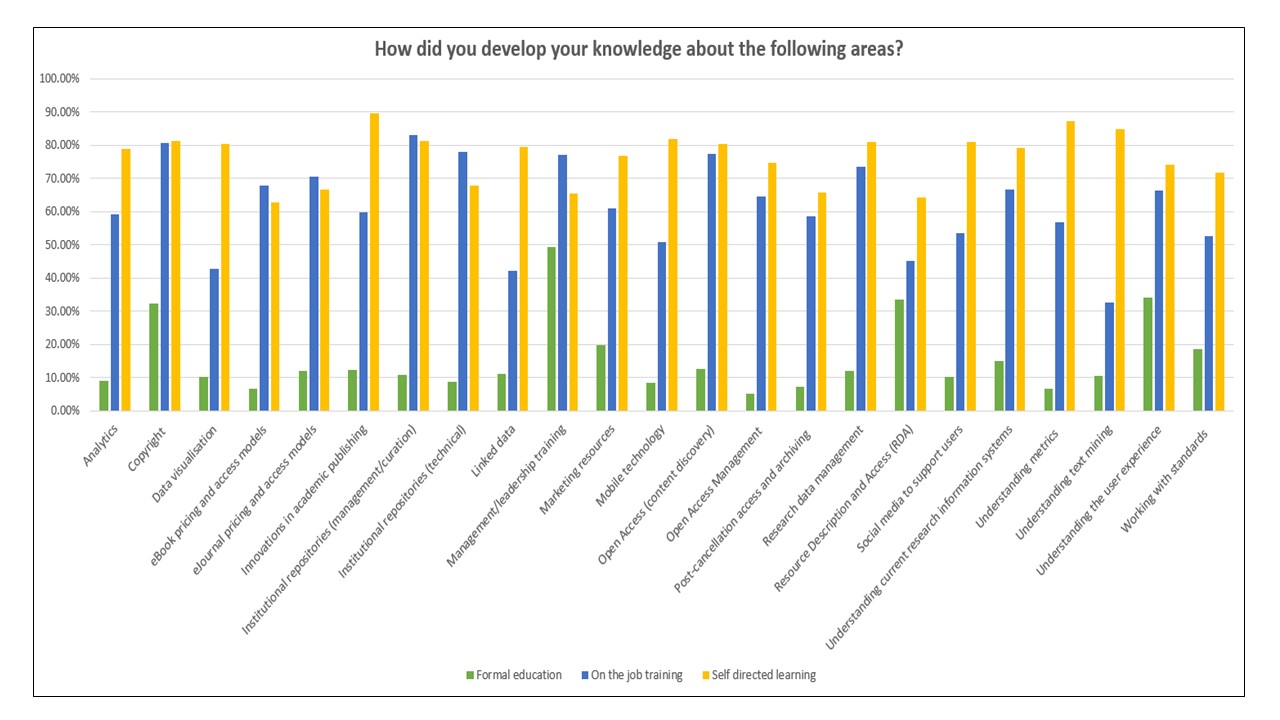
What we really wanted to know was how people working in scholarly communication developed these skills – through their formal education, on the job training or self-directed learning. Survey respondents were asked how they had developed the skills included on the UKeIG list, and their responses can be seen in Figure 3 below:

FIG 3: How did you develop your knowledge about the following areas?

Almost all of the respondents had some level of either undergraduate or postgraduate education, with 71% either holding or working towards a postgraduate qualification in library and information science. Given this, it is surprising to note that so few felt that they had developed the skills they needed for their role through formal education. This gap could perhaps be attributed to the fact that 74% of respondents have held their qualifications for a significant amount of time and so these subjects were not offered at the time. They would have had little choice but to learn these skills on the job or in their own time as it was unlikely to be practical to return to formal education.

Generic skills on the list scored much higher with participants for formal education, perhaps because library school courses are designed to produce well-rounded information professionals able to work in a variety of sectors and so cover the skills that are most likely to be of use in a broad career.

Looking at the results in more detail we can see that a potential skills gap is being created. Looking at the top five skills respondents’ have identified as using in their current role we can see that the levels of formal learning for each are low (Figure 4).

FIG 4: Current needs: How are these skills being addressed?

There is evidence that this skills gap could continue into the future. Figure 5 shows the top five skills respondents think will be of most importance to the future of the profession. Again the numbers developing these skills through formal education are low, showing that those working in scholarly communication are having to rely on either on the job or self-directed learning to develop the skills they identify as being important to the future of the profession.

FIG 5: Future needs: How are these skills being addressed?

Next steps

We will continue to analyse the results of the survey to find out more about how those working in scholarly communication have developed their skill sets and how they see future offerings being delivered. In the meantime the OSC is part of a group which is looking to tackle the provision of dedicated scholarly communication in the UK. As well as sharing our discussions on this blog you can talk to us at various events. We have already visited RLUK and are scheduled to present at LILAC and CILIP Careers Day so do come and chat to us if you have a chance!

Originally published: Unlocking Research, March 23rd 2018

Friday, 23 February 2018

Cool Cartoons

One of my biggest achievements of 2017 was having my first peer reviewed article published in the New Review of Academic Librarianship. It was an intense experience and I learnt a lot - not least to cut our research community a bit of slack. I was only writing one article - they write several! 

I was thrilled to learn at the end of the year that the article was being turned into a cartoon abstract. These are cartoon versions of the usual textual abstract that goes with the article. They come in a variety of formats depending on the interpretation of that particular artist(s). Cartoon abstracts are also a really good way to make an instant impact with your article. The saying that a picture is worth a thousand words is true - the casual reader's attention is caught more by a an image than a paragraph of text that they have to read through. It also great to see someone else's interpretation of my work (particularly as I'm not artistic myself). Plus, it's kind of cool!

You can see the cartoon abstract by clicking below and you can read the accompanying article here (OA).

The Research Support Ambassador Programme

Monday, 5 February 2018

Dealing with the Green-Eyed Monster

This is one of those posts that I probably shouldn't write but it's been niggling me for a while and perhaps the only way to make it go away is to write it. It's not intended to get sympathy or beg for reassuring comments, more just something I need to put down on (digital) paper. 

I want to talk about professional jealousy. We all experience it - that feeling of irrational rage when someone else has done something you wish you had, achieved a goal that seems out of your reach or has just done something better than you. It's natural to feel jealous in this sort of situation and it can be a good motivator to work harder or get out of your comfort zone. I know that I wouldn't be in the role I'm in today if I wasn't occasionally jealous of the success of my colleagues and pushed myself that bit harder. This is the positive side to jealousy but what about the negative? At the extreme it can lead to people making nasty comments and you becoming the outsider. Unfortunately this is something I've experienced quite a lot recently, both in my day job and in the other professional commitments that I have. Things have been going well with work, both for me and my wider department but with that success comes the flip side. It can range from flippant comments such as people telling me I shouldn't complain about being tired because it's my own fault for taking on too much, through to more 'organised' moaning that gets back to you through the local grapevine. 

This isn't really a new feeling for me. I've always been something of an overachiever - doing more work than necessary and taking on too much. When I was at school I was often referred to as a swot and was bullied for it. Typical kid stuff that we all go through and that has fueled the plots of some great 80s high school movies. The thing it, I'd sort of hoped that as we got older, left school and moved into jobs which turned into careers, the taunting would stop. Or at least people would get the sense to keep their comments to themselves. Sadly it seems that this isn't the case and recently I've been feeling that I've gone back about twenty years. I still tend to take on too much and get involved in a lot of projects (in a similar way to many other information professionals I know!). In the beginning I did this in a bid to impress my then-bosses into giving me a permanent job and then afterwards because I found that I enjoyed getting involved. And maybe I'm a bit addicted to that nice feeling of knowing people like something I've done. I certainly like helping people and get a lot of satisfaction this way from both my job and my extra curricular activities. It doesn't stop the jealousy getting wearing though, especially when you have a lot on your plate.

So how do you deal with the green-eyed monster? If you are one of those experiencing jealousy then remember that it's natural. As I've said above it can be a great motivator if used correctly and can really help to push you to achieve something. If you are jealous of a colleague then stop and think about how they've got what it is you want. You could even use it to start a conversation with them and learn about the steps they've taken to get where they are. If they're anything like most people in this profession they will be more than happy to help you with a bit of friendly advice. You may even have to do a bit of introspection and acknowledge that it's your problem rather than theirs. The bottom line is be a grown up and remember that no matter how you intend your comments, they can get lost in translation and get back to the other person. And if you're on the receiving end? Then try and see it for the pettiness it is and let it pass you by. It's easier said than done I know, and sometimes it can build up and really wear you down. If people aren't saying these things to your face and you hear about them second hand it's probably because they know they're in the wrong. In the same way that bullies will put you down because it makes them feel better, the irrationally jealous will know on some level that they're being juvenile. If they had a genuine comment to make that could be backed up with logical argument they would start a conversation with you rather than whispering when they think you can't hear them. But think of it like this - you must have done something right for these people to be jealous of you. Keep focusing on that and doing what you're doing and hopefully that will be enough to get you - and me - through!


Friday, 26 January 2018

Developing the Staff of the Future: Training Librarians in 2017

This post is reblogged from Unlocking Research, the blog of the Office of Scholarly Communication, Cambridge.

2017 was an exciting year for training our library community. As well as continuing to cover the basics of research support, the OSC was able to introduce new topics and new methods of delivery to ensure that Cambridge library staff have all the information they need to support the research community. In this blog post our Research Support Skills Coordinator Claire Sewell reflects on the successes of the past year and her plans to make 2018 even better.

This time last year I was reflecting on my first full year in my role, having started in November 2015. After more than two years in the role some things have remained constant but there have also been a great many changes in training, so it seemed like a good idea to stop and reflect again.

The OSC runs two parallel professional development schemes for library staff: Supporting Researchers in the 21st Century and the Research Support Ambassador Programme. Supporting Researchers is open to all library staff and offers a regular programme of training in areas related to research support throughout the year. The Research Support Ambassadors programme is a more intensive programme which runs every summer and is designed to create a library workforce who feel confident in helping researchers with their queries.

Supporting Researchers in the 21st Century

The world of the academic library is changing and it’s important that institutions work to equip the staff with the knowledge they need to take advantage of these changes. The Supporting Researchers programme offers a range of training opportunities from general talks to in-depth workshops which are designed to help staff keep on top of the rapidly changing world of scholarly communication.

In 2017 we ran twenty-three training events catering to the needs of over four hundred staff. In addition to covering some of the expected areas such as Open Access and Research Data Management we looked at some new areas such as Text and Data Mining and predatory publishing. These sessions proved to be a hit with attendees, with 70% of those attending rating the sessions as ‘excellent’. They were also enthusiastic in their feedback:

Excellent session on predatory publishers. We’ve started to get a lot of questions in this area and knowing more about it came at the perfect time

It was really engaging and a perfect introduction to the topic. I only had a vague idea at the outset as to what predatory publishing is but by the end of it I felt really well-informed (and in a short space of time!)

In order to help staff plan their time and attendance we experimented with forming sessions into mini programmes which resulted in our Librarian Toolkit sessions on Helping Researchers Publish and Open Access. This seemed to be successful so it’s something we’ll be continuing in 2018. By far our most successful session was How to Spot a Predatory Publisher, which was delivered in direct response to demand from staff who were getting a lot of questions from their users on the topic. It was so successful that we’ve gone on to produce some local guidance and a webinar which has over 300 views to date.

Research Support Ambassador Programme

In 2017 the Research Ambassador Programme ran from August to October and attracted eighteen participants from across colleges, departments and the University Library. We tried something a little different this year by making most of the training available online. Librarians are notoriously busy people and coupling this with summer holidays and the introduction of a new library management system meant that it would have been impractical to schedule in a host of face-to-face sessions. The initial introductory workshop ran as an in-person session to allow Ambassadors to meet each other and put faces to names but all other sessions were delivered as interactive webinars.

Although formal feedback is still being collated, initial responses have been positive:

I feel much more confident now that I have a good overview of all the issues confronting researchers and I will be able to know how to train researchers and who to refer them to for more information

Thanks for the programme. The content was really interesting and delivering via webinar was helpful as I didn’t have to leave my desk. I feel much more confident in dealing with researcher questions now.

Now that we have three cohorts of past Research Ambassadors in Cambridge it’s time to expand the programme for those still wishing to be involved. It’s hoped that this will create a community of research support librarians and strengthen it into the future as new staff take part in the programme.

Webinars

Introducing a new training format is always a challenge but in the case of OSC webinars it’s one where the hard work has paid off. Many library staff have commented over the past two years that although they would like to attend training session they can’t due to issues with library staffing and other commitments. Repeating sessions and varied scheduling helps to some extent but we felt that more could be done. Having attended many webinars myself I knew they were a great way to attend training without having to leave my desk, especially if recordings could be accessed at a later date.

Over the course of 2017 the OSC delivered a total of nine webinars for library staff. Feedback on the format from library staff was positive:

Working in a small Library where most staff are part time makes it difficult to get out of the Library to attend training so being able to take part online was great.

I really enjoy the ability to listen back at a convenient time; I often cannot leave the library at short notice due to lack of cover, or unforeseeable research enquiries that overrun and unfortunately take precedence over courses etc.

Nice and flexible - can watch from anywhere!

As a result of this success, the webinar format is now being used for additional training for both the research community and an audience beyond Cambridge.

Moving beyond Cambridge

It’s also been a busy year for training library staff outside Cambridge. In May I went to talk to CPD25, the staff development programme of the M25 Consortium of Academic Libraries on Making the Modern Academic Librarian and gave a presentation on the Librarian as Researcher to CILIP in Kent in November. I was also lucky enough to visit Salzberg to talk about the skills librarians can bring to the support of Text and Data Mining. The OSC has also been involved in talking to other interested stakeholders about the wider need for research support training for library staff which has led to some exciting progress.

We’ve also been busy talking about Cambridge initiatives to the wider world. In April 2017 I went to LILAC – the major information literacy conference for librarians – in Swansea and gave three presentation including a poster on the Supporting Researchers in the 21st Century programme, a presentation on the Research Support Ambassador programme and a workshop on Engaging Students with Research Data Management. This has led to a wider interest in these programmes and the issue of research support training more widely.

Perhaps the biggest impact we’ve had has been the publication of an article on the Research Support Ambassador Programme in the New Review of Academic Librarianship. To date this has had over two thousand views and was the most read article published in the journal in 2017. I was very excited to discover this week that it has its first citation and that it has been chosen to receive a cartoon abstract as part of the launch of the publisher’s new librarian platform this year. Lots to look forward to!

Future plans


So, what next? Plans for the Research Support Ambassadors are moving forward and we have several interesting sessions lined up for our librarians already. There has also been a lot of interest in offering training to a wider audience starting with a session on Moving Into Research Support in February and more to come. Hopefully there will also be more publications in the future and of course updates on this blog. The OSC is very much looking forward to working with our library community throughout 2018 and beyond to bring them more exciting training opportunities. 

Monday, 18 December 2017

Biting the Bullet

Being someone who loves all things stationery I've come across bullet journals before. I always thought they sounded like a good idea but never really got round to coming up with one of my own. Recent changes in my personal circumstances mean that I need to start getting organised and whilst out Christmas shopping I spotted this so decided to take the plunge. Luckily my colleagues at the Engineering Library in Cambridge were offering a class on using bullet journals to become more organised so I attended and picked up some valuable tips.

Bullet journaling is a system for creating your own bespoke diary/notebook/calendar system. Pre-printed planners are great but they don't always work for everyone. People find that they never use some of the sections but run out of space in others. Using a blank notebook, the bullet system allows people to record their plans and to-do lists in a way that suits them. Bullet journals can be created from any type of notebook and customized to suit the individual. They can be as simple or as complicated as you like (if you want to get sucked down a rabbit hole look on either YouTube for inspiration or on Amazon for stencils, stickers or washi tape).

Tasks are recorded using a basic range of symbols:


The beauty of these symbols is that they all start with a dot and can be changed as needed. Once a task has been completed you can put a cross through the dot, when a task is migrated to a new day it can be turned into a greater than symbol and so on. Entries onto these lists are short and to the point (although you can have a longer diary-like section). The idea is that you can glance at the journal and see exactly what you've already done and what you still need to do.

When setting up your bullet journal one of the first things to do is set up an index. This comes at the start of the book and is essentially a content page. Whereas a traditional planner will be divided into sections where calendars sit together, to-do lists in another section and notes in yet another section, a bullet journal lets you start new sections wherever you like. There is no worrying about leaving a certain amount of pages free, you just fill up the notebook as you go along. Therefore having an index helps you to keep track of everything - for example everything referring to January might be on pages 7-11, 25-31 and 45. Although it might seem like a counterintuitive way to work it actually helps to keep things sitting side by side. For example the notes from work meetings can be found near the calendar entry for the meeting which helps to keep things fresh.

There are many different spreads or lists you can choose to put into your journal depending on what you need to plan. You can have calendars to show you the next two, four or six months ahead as well as weekly and daily diary entries. You can include one long to-do list or different lists for every aspect of your life. You can track your fitness levels and plan your meals. Whatever you feel you need.

Putting together the journal takes some time at the beginning but everyone is keen to stress that the system is adaptable. If you try something and it doesn't work then move on. If having a meal planning list becomes more of a chore than a help then ditch it. If you find that having a monthly to-do list is too much then have a weekly one. Bullet journals can be used for both work and home to let you see your life at a glance although you can have separate ones if you feel the need. If you want to be artistic or include extra elements you can but the advice I received was to start simple and work your way up to more complex layouts.

I'm hoping to get started with bullet journaling in the new year but one thing my colleagues pointed out was that there is a community out there around this form of organisation. A quick Google gives lots of interesting ideas for layouts and spreads (I'm getting the lingo!). People are happy to share their designs and you can be inspired, no matter how much you might struggle on your own. I've already been out and bought some coloured pens and washi tape - the only thing left to do now is get started!

Credit for all of these tips goes to Emma Etteridge and Kirsten Lamb at the Engineering Library, Cambridge, Michelle Bond, Coventry University Library and How to bullet plan: a practical guide by Rachel Wilkerson Miller.

Friday, 17 November 2017

Moving into Research Support: What Librarians Really Need to Know

I've been doing a lot of work in the past year or so on educating the library community beyond Cambridge about scholarly communication and research support from blog posts and surveys to speaking at events. In 2018 I'm aiming to formalize this by offering a course on Moving into Research Support in collaboration with CILIP and CILIP East.

It's quite hard work to condense everything a librarian might need to know about research support into one three hour workshop but I'm enjoying the challenge. What I'm really hoping to cover is what library staff really need to know to get started, whether they are new to the world of research support, have had these duties added to their current post or are just interested in exploring the sector and its various roles. Hopefully this will be enough to get people started and help them to grasp the basics of scholarly communication.

In the course I'll be covering: 
  • An introduction to scholarly communication in the 21st century
    • What do we mean by scholarly communication?
    • What does it mean to be a researcher in the 21st century?
    • Where the library fits into the research lifecycle
    • The different roles available for librarians in library and information support
  • Research Data Management
    • What do we mean when we talk about 'data'?
    • Why should researchers learn how to manage their data?
    • How can libraries support researchers across disciplines with their data?
  • Open Access
    • What is Open Access?
    • What are the implications of research funder policies for researchers?
    • How can librarians keep up with the changes? 
  • Disseminating research
    • How can researchers share their research once it's completed?
    • How can they take advantage of new and innovative methods of dissemination?
    • How can librarians support researchers with sharing their work with the wider world?
  • Metrics and measuring impact
    • Why are metrics and why are they important?
    • Why do researchers need to measure impact?
    • How can libraries support researchers with understanding and applying metrics?

I hope this will be a valuable introduction and there will of course be signposting towards further information on different areas so people can explore further if they want to. If this course turns out to be a success who knows what might be next? I'm really enjoying pulling the content together and it's giving me lots of ideas about the skills that librarians really need in this area which is something I hope to do more investigation on in 2018.  

If you are interested in the workshop the course takes place on February 1st and details and booking information can be found via the CILIP website here. 

Thursday, 9 November 2017

Librarians as Researchers: Methods, Lessons and Trends


Yesterday I travelled down to Canterbury to speak at a CILIP in Kent event Themes and Trends in Library and Information Research. It was a really enjoyable day and I learnt a lot about current research trends from my fellow speakers. For anyone interested I've included my slides and a summary of my talk below.

I started by talking about my various roles, both my job and outside of work. This wasn't done in any way to show off but to demonstrate that all sorts of people can undertake research. In my day job I train Cambridge library staff in scholarly communication and research support which means learning about the research process. I've also dipped my toe into the research pool by working on a few small research projects. Sitting on the editorial board of a journal gives me an insight into the traditional publication process which is useful for my role. I'm not someone who thought they would ever be a researcher, no matter how part time, and hopefully I got this message across to attendees.

Given all the demands on the time of the librarian why should they take on the additional role of researcher? I would argue that it's something they already do in their day jobs. When you want to solve a problem you investigate all of the solutions, choose one to implement, test it and then evaluate it. This is essentially research by another name. Undertaking research can help to give weight to your arguments, especially your managers. You may know that something isn't working or that there is demand for a certain service but taking evidence to the person who holds the purse strings can have a bigger impact. For some it's a required part of their role but even if it isn't then doing some research can make your CV stand out and enhance your skill set. The research process can obviously develop an understanding of research but it also develops project management, communication and critical thinking skills to name a few. Lastly doing research helps to satisfy the natural curiosity of the librarian.

The number of practitioner-researchers has been growing over the last few years but why is this? There has been an increase in the training available on research recently - a quick Google finds a range of training courses, books and presentations on the topic. This comes with a growing realisation that librarians have been undertaking quality research for a long time, for example the work that is produced during postgraduate study for a library degree. Happily there are now ways to showcase this research such as the LISDIS conference. People are also moving beyond the traditional methods of sharing their research like conferences and peer reviewed journals and towards social media which is helping to make it more accessible to a wider audience and getting it out of the academic echo chamber. The increasing number of research support roles available means that more library staff are needing to understand the research process and are trying out small projects. The result of all these developments is that the research process as a whole has been demystified. Whereas it once used to be closed off it is now more open to a wider range of people which can only be a good thing!

So what are the current trends in LIS research?
  • Evidence-based librarianship - this has it's roots in the health and education and sectors and is the theory that decisions should be made based on evidence. This can be a powerful bargaining tool with management who are less likely to argue if you can produce solid evidence to back up your ideas
  • More practitioner-researchers - there has been an increase in the number of active practitioners doing some form of research and sharing the results. This leads to new networks being formed which help people to share best practice and encourage them to develop as researchers
  • Link between theory and practice - research has tended to focus on the this is what we did and how we did it case study approach but there is a growing interest in the theory that underpins the work we do. A good example of this is teaching. Librarians are often required to teach as part of their work but many are now starting to think about the pedagogy which informs that teaching. Why do we teach as we do? Is there a way to improve it? This inevitably leads to questioning things more
  • Trendy trends - every discipline has its trendy topics and librarianship is no different. A few years ago it was ebooks, now UX and scholarly communication are in vogue. Communities build up around these areas and form their own research patterns and trends which then begin to influence the next trend. If you can spot the next trend first then you are ahead of the curve!
  • Failure - this is one trend I'm really pleased to see. Librarians are becoming more open to talking about what doesn't work which can be a really valuable learning experience. This is a general trend in scientific research but it seems to be crossing into other sectors which is great as it has previously been hard to get published in these areas. The tide is now changing and there are publications and even conferences dedicated to sharing failures
  • Trying something new - the final trend is the chance to try something a little bit different. New areas of research are emerging all the time as librarians move to work in ever expanding areas, they're drawing ideas in from other disciplines and trying new research methods. There are also more chances to collaborate with others outside your institution or even outside librarianship. This can lead to lots of exciting new opportunities to pursue research projects and promotes good working relationships with those outside the library
We're working on developing the librarian researcher community at Cambridge through training and encouragement. One thing that has been successful so far is a Community of Practice which meets regularly to discuss a different aspect of the research process. This helps to answer questions and move projects along and has been really useful for me personally as I try my hand at research.

As a final thought I found the following quote from Zora Neale Hurston: 
Research is formalised curiosity. It is poking and prying with a purpose. 
Librarians like to poke away and find the answers - it's what we're trained for. Doing research just gives a formal structure to this curiosity. If we use our knowledge, skills an natural curiosity then we can become the librarian researchers of the future.